

What is electroporation and how does it work? Learn the principle of electroporation, electroporators, cuvettes, DNA and RNA transfection, reversible vs irreversible electroporation, applications and optimization.
What Is Electroporation?
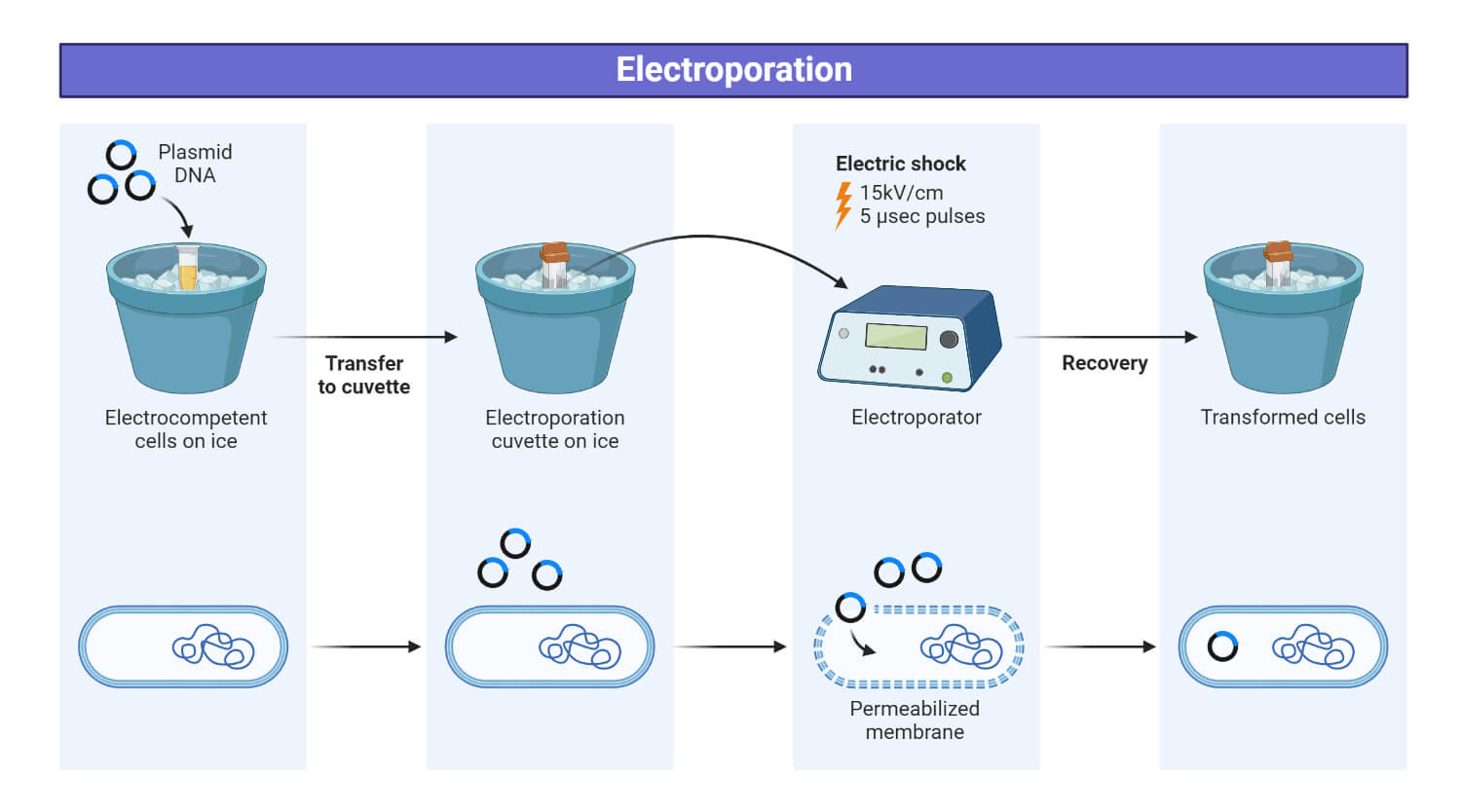
Electroporation is a physical technique that uses short electrical pulses to increase the permeability of a biological cell membrane, enabling molecules that normally cross the membrane inefficiently to enter cells.
- Image Reference : Microbes Notes
The technique is also called electropermeabilization.
When cells are exposed to an appropriate electric field, the electrical potential across the plasma membrane increases and structural rearrangements occur within the lipid bilayer. This produces a transient permeabilized state that can facilitate intracellular delivery.
Depending on the electrical conditions, electroporation can be :
- Reversible electroporation → membrane permeability increases temporarily and viable cells can subsequently recover.
- Irreversible electroporation → membrane damage is sufficiently extensive that cells fail to recover, leading to cell death.
For molecular biology, reversible electroporation is particularly important because it can be used to introduce DNA, RNA and other molecules into living cells.
Quick Answer
Electroporation temporarily increases cell-membrane permeability by exposing cells to controlled electrical pulses. During reversible electroporation, molecules such as DNA or RNA can enter cells before the membrane recovers. The method is widely used for transfection, genome editing and intracellular delivery. Stronger or otherwise damaging pulse conditions can instead produce irreversible electroporation and cell death.
How Does Electroporation Work?
The basic principle of electroporation involves the interaction between an external electric field and the cell membrane.
A biological membrane normally acts as a selective barrier separating the intracellular environment from the extracellular environment.
When an external electric field is applied, electrical charge accumulates across the membrane.
If the resulting transmembrane potential becomes sufficiently high, the organization of the lipid bilayer can be disrupted and membrane permeability increases. Molecular models support the formation of water-containing pathways within the lipid bilayer during this process.
The process can be simplified as :
Cells + cargo
↓
Electrical pulse
↓
Increase in transmembrane potential
↓
Membrane permeabilization
↓
Cargo enters the cell
↓
Membrane resealing
↓
Viable transfected cells
The last two stages describe reversible electroporation. Under more damaging conditions, cells may instead undergo irreversible injury.
What Happens to the Cell Membrane During Electroporation?
The cell membrane consists primarily of a phospholipid bilayer containing proteins, cholesterol and other components.
Under normal conditions, this structure forms an effective barrier to many hydrophilic and charged macromolecules.
An applied electric field alters the electrical forces acting across the membrane.
Experimental and computational studies support a model in which water penetrates the lipid bilayer and membrane lipids reorganize around water-filled defects. These structures increase membrane permeability.
This phenomenon explains why electroporation can facilitate intracellular delivery without relying exclusively on chemical or viral delivery systems.
What Is an Electroporator?
An electroporator, sometimes called an electroporation machine or electroporation device, is an instrument designed to generate controlled electrical pulses for electroporation.
Laboratory electroporators allow researchers to control parameters such as :
- Voltage.
- Electric-field strength.
- Pulse duration.
- Number of pulses.
- Pulse interval.
- Pulse waveform.
These parameters strongly influence both delivery efficiency and cell viability.
The appropriate settings depend on the electroporation platform, electrode geometry, buffer, cell type and cargo being delivered. Optimization is therefore essential rather than assuming that one electrical setting works for every experiment.
What Is an Electroporation Cuvette?
An electroporation cuvette is a specialized vessel containing electrodes used to expose a cell suspension to an electric field.
A typical workflow places cells and the molecule being delivered into an appropriate electroporation buffer inside the cuvette.
The cuvette is then connected to the electroporator.
When the pulse is delivered, an electric field develops across the gap between the electrodes.
Because electric field depends on both the applied voltage and electrode geometry, cuvette gap size matters when interpreting electroporation conditions.
For this reason, simply copying a voltage from one system to another may not reproduce the same electric-field condition
What Can Be Delivered by Electroporation?
One major advantage of electroporation is its versatility.
Depending on the cell type, platform and optimized protocol, electroporation has been investigated or used for intracellular delivery of :
| Cargo | |
| Plasmid DNA | Transient or stable gene expression |
| mRNA | Transient protein expression |
| siRNA | Gene-silencing experiments |
| Guide RNA | CRISPR genome editing |
| Ribonucleoprotein complexes | CRISPR/Cas genome editing |
| Proteins | Functional intracellular delivery |
| Small molecules/drugs | Experimental or therapeutic delivery |
| Molecular probes | Cellular analysis |
Reviews of electroporation-based delivery describe applications involving DNA, RNA, drugs, proteins and other intracellular cargo.
Electroporation for DNA Transfection
One of the most established laboratory applications is DNA electroporation.
In this approach, cells and plasmid DNA are exposed to an optimized electrical pulse.
The increased membrane permeability allows DNA to gain intracellular access.
After successful reversible electroporation, cells recover and the introduced genetic material can subsequently be expressed or processed depending on the experimental system.
Electroporation became particularly important as a non-viral transfection strategy because it can be applied to numerous cell types and does not inherently require viral vectors.
Reference : Pubmed
Electroporation vs Transfection: What Is the Difference?
These terms are related but not identical.
Transfection describes the introduction of nucleic acids into eukaryotic cells.
Electroporation describes a physical membrane-permeabilization method.
Therefore :
=> Electroporation can be used to perform transfection.
For example:
=> Plasmid DNA + cells + electroporation → DNA transfection
Electroporation can also deliver cargo other than nucleic acids, so its applications extend beyond conventional transfection.

Electroporation for CRISPR Genome Editing
Electroporation has become important in CRISPR genome-editing workflows because editing components must reach the interior of cells.
Depending on the experimental design, electroporation can facilitate delivery of :
- Cas nuclease mRNA
- Guide RNA
- Plasmid DNA
- Cas protein–guide RNA ribonucleoprotein complexes
- Donor DNA templates
This makes electroporation particularly relevant to ex vivo cell-engineering workflows.
The appropriate strategy depends on the target cell, desired editing outcome and downstream application.
Reference : Pubmed

Image Reference : Nature
What Cell Types Can Be Electroporated?
Electroporation can be applied to both prokaryotic and eukaryotic cells, although conditions must be adapted to the biological system.
Examples include :
- Bacteria
- Yeast
- Mammalian cell lines
- Primary cells
- Stem cells
- Immune cells
- Plant cells or protoplasts
- Other specialized cell systems
The fact that a cell type can be electroporated does not mean that a generic protocol will work efficiently.
Cell size, membrane properties, physiological state and sensitivity to electrical stress can substantially affect the outcome.
Reversible Electroporation
Reversible electroporation (RE) occurs when electrical exposure transiently increases membrane permeability while allowing surviving cells to restore membrane integrity.

Image Reference : ResearchGate
This is the form generally desired for intracellular delivery and laboratory transfection.
The objective is essentially to find a useful experimental window :
- Insufficient electrical exposure :
→ little membrane permeabilization
→ poor delivery
- Optimized reversible electroporation :
→ sufficient permeabilization
→ intracellular delivery
→ acceptable viability
- Excessive exposure :
→ substantial membrane injury
→ reduced viability or irreversible electroporation
This balance between delivery efficiency and cell survival is central to electroporation optimization.
What Is Irreversible Electroporation?
Irreversible electroporation (IRE) occurs when electrical exposure causes membrane injury from which cells cannot adequately recover.

Image Reference : ScienceDirecte
The resulting loss of cellular homeostasis can lead to cell death.
This is fundamentally different from laboratory transfection, where cell survival is usually required.
IRE has therefore been investigated and applied as an ablative technology, including applications in interventional oncology and cardiac tissue ablation.
Reversible vs Irreversible Electroporation

The distinction is not determined by voltage alone. Pulse amplitude, duration, number, waveform, electrode configuration and biological properties all contribute to the cellular response.
Electroporation Protocol: What Are the Main Steps?
A general laboratory electroporation workflow can be summarized in four stages.
1. Prepare the cells
Cells should be prepared according to the requirements of the specific experimental system and electroporation platform.
Cell condition is important because unhealthy or stressed cultures may show reduced recovery after electrical exposure.
2. Combine cells with the cargo
Cells are combined with the intended material, such as plasmid DNA, RNA or another molecular cargo, in a compatible electroporation solution.
3. Apply the electrical pulse
The cell suspension is transferred to the appropriate electroporation vessel or device and subjected to the validated pulse program.
4. Recover and analyze the cells
Following electroporation, cells are returned to appropriate culture conditions.
Researchers subsequently evaluate endpoints such as:
- Cell viability
- Transfection efficiency
- Gene expression
- Genome-editing efficiency
- Phenotypic changes
A similar prepare → pulse → recover → assay workflow is described in standard electroporation guidance.
Important: exact voltage, pulse duration, number of pulses and buffer composition should be optimized for the specific cell type, device and experimental application rather than treated as universal parameters.
What Factors Affect Electroporation Efficiency?
Electroporation performance is determined by an interaction between electrical parameters, biological variables and solution/device conditions.
Electric-field strength :
=> The field must be sufficient to induce useful membrane permeabilization.
=> Too little exposure can result in poor delivery, while excessive exposure can compromise viability.
Pulse duration :
=> Pulse duration influences how cells respond to the applied electric field.
=> Different electroporation technologies can use pulse durations ranging across very different timescales.
Number of pulses :
=> Increasing the number of pulses may alter permeabilization and delivery but can also increase cellular stress.
Cell type
=> Different cells have different sizes, membrane properties and tolerances to electrical exposure.
Cell condition :
Cell density, growth state and general viability can influence experimental outcomes.
Electroporation buffer :
=> Buffer conductivity, osmolarity and composition can affect both electrical behavior and cell recovery.
Cargo :
=> DNA, RNA, proteins and other cargo differ in size, charge and intracellular destination.
Temperature :
=> Temperature before, during and after electroporation can influence membrane behavior and cellular recovery.
=> Optimization therefore requires evaluation of the complete experimental system, not simply voltage.
Why Does Electroporation Sometimes Kill Cells?
Cell death can occur when electrical exposure causes damage beyond the cell's ability to recover.
Possible consequences include :
- Persistent membrane permeability
- Ionic imbalance
- Loss of metabolites
- Osmotic disturbances
- Mitochondrial dysfunction
- Oxidative stress
- Activation of cell-death pathways
Research indicates that electroporation-induced cell death is complex and can involve different mechanisms depending on pulse conditions and biological context.
This explains why maximizing transfection efficiency without considering viability can produce misleading experimental optimization.
A useful protocol should generally evaluate both delivery efficiency and viable cell recovery.
Electroporation vs Lipid-Based Transfection
Both methods can introduce nucleic acids into cells, but their mechanisms differ substantially.

Neither method is universally superior.
The appropriate approach depends on cell type, cargo, desired efficiency, viability, scale, cost and downstream application.

Electroporation Machine vs Electroporation Device
Researchers searching for an electroporation machine are generally referring to an electroporator.
However, modern electroporation technologies extend beyond traditional cuvette-based instruments.
Systems can include :
- Bulk electroporation : populations of cells are treated together.
- Cuvette electroporation : cells are exposed between electrodes incorporated into a cuvette.
- Microfluidic electroporation : cells move through or are positioned within microscale structures.
- Single-cell electroporation : electrical exposure can be applied with greater spatial control to individual cells.
Microscale and microfluidic technologies are active areas of development because they can provide increased control, precision and throughput.

Applications of Electroporation
Electroporation has developed far beyond conventional plasmid transfection.
Major research and biomedical applications include:
Molecular biology :
=> Delivery of DNA, RNA, proteins and other molecules into cells.
Genome editing :
=> Introduction of CRISPR-associated components for cell engineering.
Cell therapy research :
=> Ex vivo modification of immune cells, stem cells and other therapeutically relevant cell populations.
Gene transfer :
=> Delivery of genetic material into cells or tissues.
Electrochemotherapy :
=> Reversible electroporation can increase cellular uptake of selected cytotoxic agents in tumor tissue.
Irreversible electroporation :
=> More extensive electrical injury can be used for tissue ablation.
Microfluidics and single-cell analysis :
=> Miniaturized electroporation technologies are being investigated for precise intracellular delivery and cellular analysis.

Reference : ResearchGate
Advantages of Electroporation
Electroporation offers several important experimental advantages :
- Non-viral delivery.
- Applicable to diverse cell types.
- Compatible with DNA and RNA delivery.
- Compatible with proteins and other cargo.
- Useful for some difficult-to-transfect cells.
- Rapid physical delivery process.
- Adaptable from bulk to single-cell systems.
- Relevant to CRISPR workflows.
- Can be scaled or integrated with microfluidic technologies.
These characteristics explain why electroporation remains an important platform across molecular biology, biotechnology and biomedical research.
Limitations of Electroporation
Electroporation also has limitations.
Cell viability
=> Excessive electrical exposure can cause irreversible membrane damage.
Optimization requirements
=> Conditions may need to be optimized individually for different cell types.
Equipment requirements
=> An appropriate electroporator and compatible electrodes, cuvettes or cartridges are required.
Biological variability
=> Primary cells and other sensitive populations may respond differently from established cell lines.
Scale
=> Conditions optimized at one scale may not translate directly to another electrode geometry or device.
Therefore, successful electroporation should not be defined solely by maximum cargo uptake.
The desired outcome is usually a balance among delivery efficiency, cell viability, reproducibility and downstream biological function.
Frequently Asked Questions About Electroporation
What is electroporation?
=> Electroporation is a physical method that uses electrical pulses to increase cell-membrane permeability. Reversible electroporation can allow molecules such as DNA and RNA to enter cells before membrane integrity is restored.
How does electroporation work?
=> An external electric field increases the electrical potential across the cell membrane. Above an appropriate threshold, structural changes increase membrane permeability, enabling intracellular transport of molecules.
What is electroporation used for?
=> Electroporation is used for DNA and RNA transfection, genome editing, intracellular delivery, gene transfer, electrochemotherapy and, under irreversible conditions, tissue ablation.
What is an electroporation machine?
=> An electroporation machine, or electroporator, is an instrument that generates controlled electrical pulses used to permeabilize cell membranes.
What is an electroporation cuvette?
=> An electroporation cuvette is a specialized container containing electrodes. Cells and cargo are placed between the electrodes so that an electric field can be applied across the sample.
Is electroporation a transfection method?
=> Yes. Reversible electroporation is widely used as a physical, non-viral method for introducing nucleic acids into cells.
Can electroporation be used for DNA?
=> Yes. DNA electroporation is an established method for introducing plasmid DNA and other DNA constructs into compatible cells.
Can electroporation deliver RNA?
=> Yes. Electroporation can be used to deliver mRNA, guide RNA, siRNA and other RNA molecules when conditions are appropriately optimized.
Can electroporation be used for CRISPR?
=> Yes. Electroporation is widely applicable to delivery of CRISPR-associated components, including RNA and ribonucleoprotein complexes, in genome-editing workflows.
What is reversible electroporation?
=> Reversible electroporation temporarily permeabilizes the cell membrane while allowing surviving cells to subsequently restore membrane integrity.
What is irreversible electroporation?
=> Irreversible electroporation produces membrane injury severe enough that cells do not adequately recover, resulting in cell death. It has applications in tissue ablation.
Does electroporation kill cells?
=> It can. Cell survival depends on pulse parameters, device geometry, cell type, buffer and other experimental conditions. Optimized reversible electroporation aims to achieve useful delivery while maintaining acceptable viability.
Which cells can be electroporated?
=> Electroporation can be applied to many prokaryotic and eukaryotic cell types, including bacteria, mammalian cell lines, primary cells, immune cells, stem cells and plant-derived systems. Conditions must be optimized for the specific biological system.
Electroporation: From Cell Transfection to Advanced Biomedical Research
Electroporation is much more than a method for introducing plasmid DNA into cells.
At its core, it is a controlled interaction between pulsed electric fields and biological membranes.
When membrane permeabilization is reversible, researchers can exploit the temporary increase in permeability to deliver DNA, RNA, proteins and other molecules while preserving viable cells.
When electrical exposure produces irreversible injury, the same fundamental phenomenon can instead be applied to cell and tissue ablation.
This versatility has allowed electroporation to develop from a laboratory transfection technique into a broader technological platform spanning molecular biology, genome editing, cell engineering, microfluidics, drug delivery and biomedical research.